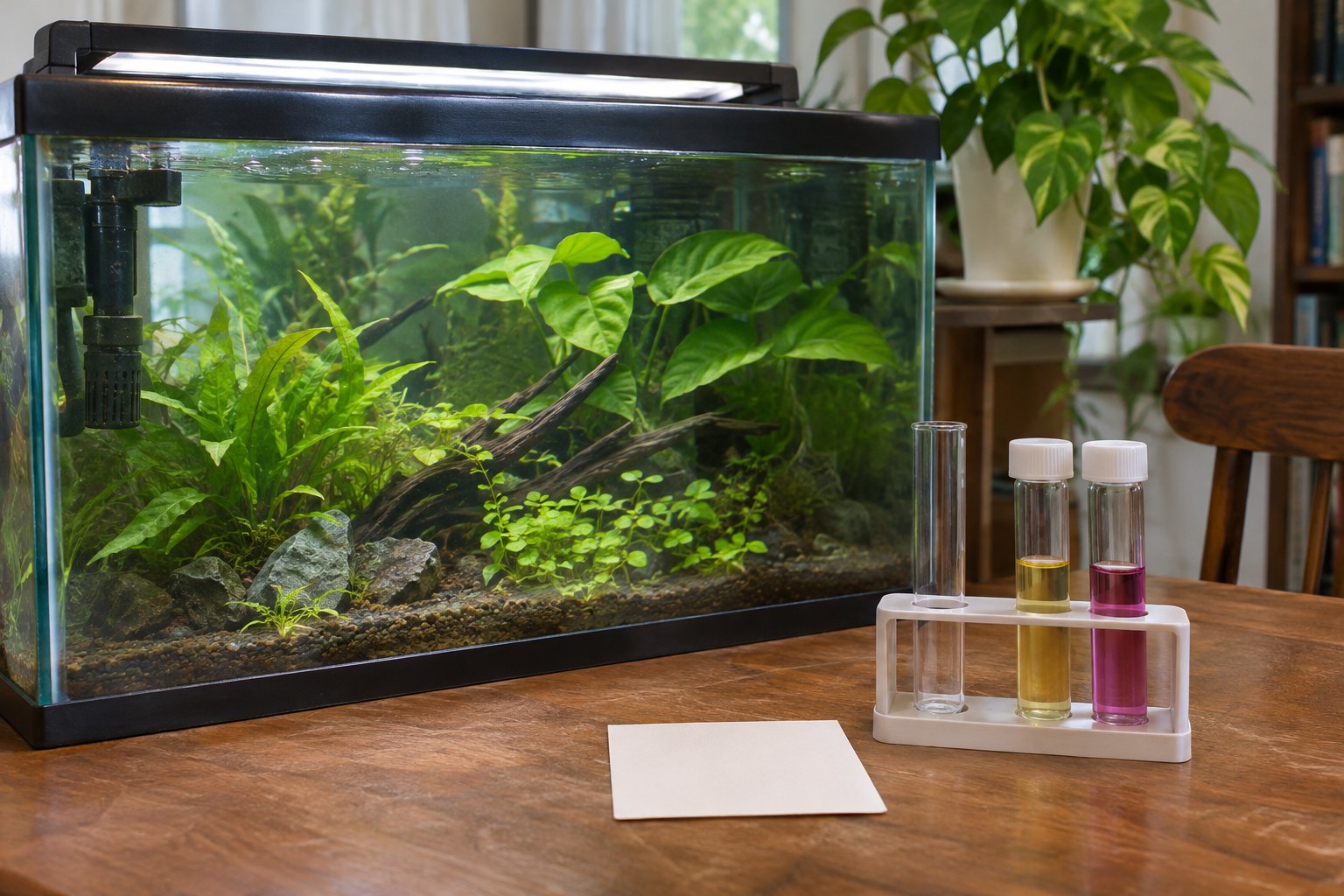
A planted aquarium can look ready long before it can handle fish waste. The useful check isn’t a count of days or a glimpse of nitrate on a test strip. It is whether the tank, with its filter running in its normal setup, can process a documented ammonia input and leave neither ammonia nor nitrite detectable at the endpoint specified by your fishless-cycling method. Before adding animals, readings should stay clear and the rest of the water conditions should suit the intended species.
Start with a test, not a dose. Plain sand or gravel usually needs a measured ammonia source. Fresh nutrient-rich aquasoil may supply ammonia on its own. Healthy plants can take up nitrogen, so a planted tank does not always show the textbook pattern. Here’s how to interpret your results without using fish, shrimp or snails as the test.
What a fishless cycle actually proves
A new filter can push out a strong stream of water without having an established biological filter. During cycling, microorganisms colonize its media and other submerged surfaces. One part of that community oxidizes ammonia into nitrite; another processes nitrite into nitrate. Both ammonia and nitrite are problems for fish. Nitrate is the end product of that pathway and still needs monitoring. The MSD Veterinary Manual’s aquarium fish guidance recommends testing all three during cycling and waiting until ammonia and nitrite are absent before adding fish.
Plants provide another route. An experiment on ammonium and nitrate uptake in aquatic plants measured both in a floating species. A falling ammonia reading does not reveal how much work the filter is doing, and a low nitrate reading does not automatically mean the cycle failed. At home, you can check how this entire aquarium handles a known input under the conditions in which you plan to keep it. Follow that check with continued monitoring, not full stocking overnight.
Most hobby kits label their lowest color as zero. Here, zero means not detectable with your test used correctly, not the complete absence of every trace. Check whether your test reports the compound or its nitrogen equivalent. A number labeled nitrite as nitrogen is not interchangeable with the same number labeled nitrite. Use directions for your exact method and kit, not a dosing chart from another brand.
Set up the tank you will actually use
Assemble the aquarium, hardscape, substrate and filter. Install biological media and run the filter continuously. If future inhabitants need a heater, install it and verify temperature with a thermometer. Make sure water moves through the media and the surface is not stagnant. Leave room to remove loose leaves and check that plant roots cannot block the intake. A tank that circulates well before planting can flow differently after floating roots fill the space in front of the return.
For the order of equipment, hardscape and planting, see the beginner’s planted aquarium setup guide.
Prepare fill and replacement water with a suitable conditioner if the supply contains chlorine or chloramine. Check what the local supplier uses and choose and dose the conditioner according to the label. Ask the test manufacturer about compatibility if conditioner or water chemistry makes a test difficult to interpret. Start with equipment free of cleaner residues.
Gather freshwater ammonia, nitrite and nitrate tests, a pH test, thermometer, notebook and marked aquarium-only container. Consider testing carbonate hardness or alkalinity if using very soft water, an active substrate or a blend made with reverse-osmosis water. For shrimp, also check the separate general hardness requirement for your species. GH and KH are different measurements.
Estimate actual water volume after substrate, stone and empty space above the waterline. Nominal capacity is not a dosing measurement. Water you measured while filling is a better starting estimate. Record prepared source water and tank readings before adding ammonia. Nitrate in source water is particularly useful context: if there was already nitrate at the start, finding it later cannot tell you where it came from.
Choose the route that fits your substrate
| Starting situation | First move | What to avoid |
|---|---|---|
| Inert sand or gravel, unstocked tank, no measurable ammonia | Use a purpose-made aquarium ammonium chloride product and follow current freshwater directions. | Using cleaning ammonia or dosing for the volume on the box without accounting for displacement. |
| Fresh nutrient-rich soil, ammonia already measurable | Log what the soil releases, follow its startup and water-change instructions, and test the trend. | Adding a full ammonium dose on top of a measurable background because a calendar says to. |
| Heavily planted from day one | Follow the substrate route, test ammonia and nitrite, and verify against a known input. | Treating thick growth, clear water or no algae as an endpoint. |
| Established media or bottled bacteria | Record what you added and verify the same endpoint as you would without a starter. | Assuming the starter guarantees capacity for all planned livestock. |
A measured aquarium product lets you distinguish a real change from an uncertain starting dose. Ghost feeding, where food decomposes in an empty tank, can supply ammonia, but it is less predictable. It is hard to tell when nitrogen from a pinch of pellets enters the water or how much the tank processes. Avoid household cleaners, which can have unknown concentrations or other ingredients.
Not every aquasoil behaves alike. Read the exact product label and test your tank. For example, the Aqua Design Amano Amazonia Ver.2 manual warns that its included supplement can raise ammonium and nitrite after setup. It tells keepers to wait until both are undetectable before introducing animals. Another soil need not behave the same way. If the aquarium starts with measurable ammonia, count it as an existing nitrogen input and hold off adding more while you clarify the trend.
A dark start is beginning with soil and hardscape in a filled, filtered tank before planting. It is a planting sequence, not another kind of nitrogen cycle or a reason to stop circulation. Test again after planting and any large substrate disturbance. A result from an earlier configuration is less useful if the tank has since changed. If you plant first, remove significant decaying tissue rather than using it as an uncontrolled ammonia load.
Fishless cycling, step by step
1. Log the baseline
Write down when you tested, what the tank contains and whether the filter was running normally. Measure ammonia, nitrite and nitrate, plus pH and temperature. Separately record prepared source water. Label both samples so you cannot confuse them. If you already have a colored ammonia result, confirm it using a clean vial and correct sample volume before planning a dose.
2. Add a known input only if the tank needs one
With no fish, shrimp, snails or other animals present, follow the dose and frequency for your exact cycling product. If its instructions allow, test after mixing to check that the starting reading matches what you expect. Record the product, amount, approximate volume and time. DrTim’s fishless-cycling product directions start with a baseline and make later dosing conditional on test results. Don’t apply its drop counts or cutoffs to a different concentration or method.
If soil or another source is releasing ammonia, keep the tank animal-free and track that input first. Keep up with any substrate-specific startup water changes. Label each change in your log so you can tell whether a lower result reflects processing, dilution or both. Don’t declare the tank ready because a large water change reduced a reading.
3. Test both ammonia and nitrite over time
Use the intervals specified by your method. Test both substances at each check. Ammonia falling while nitrite remains measurable is progress, not clearance. Look at the prior dose, elapsed time and nitrite reading before deciding whether to add anything. Follow the instructions for what to do next, not the urge to see a darker reading.
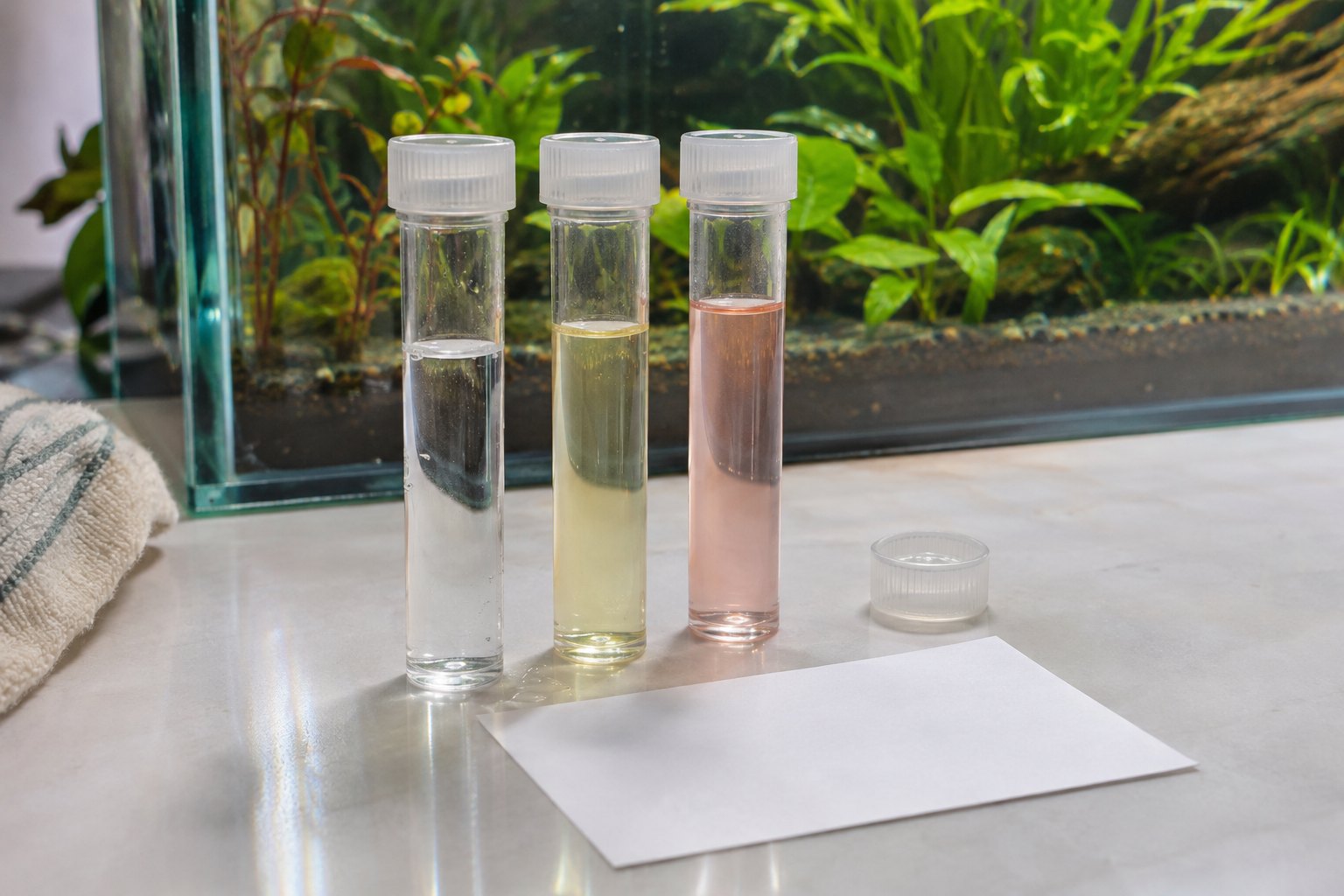
Record changes that could explain a surprise. A clogged filter, missed water treatment, large planting session or different fertilizer can tell you more than the color alone. Use nitrate as context: the tank may accumulate it, fill water may already contain it, and growing plants or water changes may reduce it. The OATA freshwater water-testing care sheet explains what to track as a new system matures and the zero ammonia and nitrite targets for an established fish aquarium.
4. Verify the endpoint before buying livestock
When ammonia and nitrite are no longer detectable and fresh soil no longer causes a rebound between changes, follow the finishing check for your controlled method. If it uses a timed ammonia challenge, record the prescribed input, verify delivery as directed and test at the required endpoint. Some methods specify a next-day check. If ammonia or nitrite is still detectable at the endpoint, wait, investigate and retest under the method’s instructions. If you never documented an input, an all-clear result from an empty tank is only a baseline.
Do not use a challenge when animals are present, even hitchhiking snails. Don’t keep repeating a large dose after a successful check. If the tank will stay empty an extended time, follow your method’s directions to maintain the biofilter and recheck before stocking instead of relying on an old result.
5. Check the rest of the water, then add animals gradually
Review nitrate, temperature, pH, and hardness or other conditions your species needs. If a partial water change is needed, match the new water to the relevant conditions and prepare it properly. Confirm results in the actual tank the fish or shrimp will enter. Keep the filter media in place and operating. Never use an animal introduction to test whether a replacement filter works.
Plan a modest first introduction that meets the species’ social needs. Gradual stocking does not mean putting a lone schooling fish in as a test. It means choosing an appropriate initial group for a verified system without adding every proposed group and its feeding load at once. OATA’s freshwater aquarium setup and care guidance explains why every increase in feeding or livestock adds demand to the filter. Test after the initial addition and before adding more.
Read the result: three planted-tank examples
Sand-bottom tank: ammonia clears, nitrite doesn’t. You confirmed a known input yesterday. Today the ammonia vial reads zero but nitrite is clearly above the lowest color. Do not stock or automatically redose. The tank has not passed the nitrite part of the endpoint. Check the product’s retest steps, keep the filter running, and look at pH and alkalinity if progress has stopped.
Aquasoil tank: ammonia returns after a water change. The reading was low immediately after replacing part of the water. The later rise means the aquarium still has an input, perhaps from fresh substrate or decaying plants. Document both readings, continue the specified water changes, remove decaying tissue and hold livestock. The objective is not one favorable reading but clear results under ordinary conditions and a verified endpoint.
Heavy planting: the input clears, nitrate stays low. You confirmed the input and both ammonia and nitrite met the endpoint without a water change during the check. Compare nitrate with your baseline and double-check the test procedure. Low nitrate alone is not a failure or proof that the biofilter independently processed every part of the input. Keep the filter and plants stable and test after adding an appropriate first group.
If progress seems to have stopped
Both vials read zero from the first day. Check whether there was an input at all. Clean fill water can give those readings before any capacity has developed. Check the setup and use the measured route if the substrate is inert and the tank is animal-free.
Ammonia doesn’t fall or nitrite exceeds the chart. Stop adding more. Verify test range, units, timing and handling. Check filter operation, temperature and water preparation. Follow your method for bringing an excessive reading back into range. An out-of-range result is not a number you can work out from the darkest square.
pH is drifting down and alkalinity is low. Compare source water with the tank over several tests. The biofilter uses alkalinity, and some planted setups deliberately use soft water or active soil. Get advice from an aquatic specialist if desired conditions and your method work against one another. Don’t chase a pH target through abrupt chemical additions, especially after animals arrive.
Today’s color contradicts yesterday’s. Repeat the test before a large change. Read it at the instructed time and against the recommended background. Follow the kit’s instructions for sample volume and shaking. Check the expiration date and use separate clean vials. If uncertain, bring a fresh sample and your log to a reputable aquarium shop or contact the kit maker. If animals are showing distress, seek a veterinarian experienced with fish rather than trying a new cycling experiment.
Save this readiness checklist
- The aquarium is animal-free, the filter is running and final equipment is in place.
- You know the substrate, tested the baseline and recorded a finishing input under your method.
- Ammonia and nitrite both read undetectable at the specified endpoint; follow-up results show no rebound.
- You did not use dilution or an unreadable test as evidence of processing.
- Nitrate and the other water conditions suit the planned animals in their final tank.
- You have a modest, species-appropriate stocking plan and will keep testing afterwards.
A useful log entry has six fields: time, ammonia, nitrite, nitrate, pH and temperature, and what changed. Under what changed, note the actual event, such as adding a measured input after baseline or replacing water before sampling. Day numbers alone won’t explain why one result differs from another.
Frequently asked questions
How long does a planted tank take to cycle?
Plan for weeks, not a guaranteed date. Setup conditions, microbial populations and the ammonia source matter. The MSD Veterinary Manual notes that a tropical tank biofilter can take up to eight weeks to establish. Treat that as planning context, not a deadline or a substitute for test results.
Can I add plants during the cycle?
Often, yes. Fishless means withholding animals, not necessarily plants. Tropica’s planting sequence illustrates planting at setup. Choose suitable plants and follow the substrate’s startup directions. Planting later can make sense when soil is releasing substantial ammonia or when you want to separate the early soil stage from plant acclimation. Test again after planting.
Does bottled bacteria or old media skip the waiting?
Either can help establish biological filtration, but neither replaces measurements. Use fresh, properly stored bottled culture according to its directions or wet media from a healthy established tank without depriving the donor of filtration. Avoid transfers from tanks with unexplained illness. Verify before stocking.
Is a cycled tank ready for cherry shrimp?
Clearing ammonia and nitrite is necessary, not sufficient. Identify the shrimp species, verify other water conditions and temperature, and check for stability and developing grazing surfaces. A newly cycled tank is not necessarily a mature shrimp habitat. See OATA’s freshwater shrimp and snail care guidance for maturity and water-quality considerations. Don’t buy shrimp to tidy up a tank with unstable readings.
Once the tank meets the shrimp’s needs, these cherry shrimp aquascape layouts show where to leave room for feeding and maintenance.
What if I already put fish in?
Do not add ammonia or follow a fishless dosing recipe. Test promptly, don’t add more animals and seek fish-specific advice to protect the animals and correct the water. Persistent detectable ammonia or nitrite, gasping or marked lethargy warrants prompt attention.
